
Let’s be completely real for a second, beautiful: shopping for a bra when you have a full bust, a plus-size body, or pendulous breasts often feels like an extreme sport. You walk into a brightly lit department store, hand your trust over to a well-meaning fitter with a measuring tape, and somehow walk out wearing a 44DD that still rides up in the back and gives you the dreaded "quad-boob" in the front.
If you are constantly adjusting your straps because they slip off your shoulders, pulling down your band because it rides up between your shoulder blades, or dealing with underwires that angrily poke your armpits all day long, I have some incredible news for you: your body isn't the problem. The bra industry's outdated math is the problem.
Best bra size calculator
If you've been frantically searching the internet for the best bra size calculator, you have likely noticed a frustrating trend. Most sizing charts and online calculators only ask you for two simple pieces of data: your underbust and your standing bust.
While that minimalist approach might work perfectly for someone with very firm, self-supporting breast tissue in a B-cup, it is an absolute recipe for disaster for plus-size women. Why? Because gravity exists!
When you only measure your bust while standing up straight, you are almost certainly underestimating your true cup volume. Soft tissue settles lower on the chest wall. Our advanced 5-point calculator acts like a virtual, highly experienced boutique fitter. By calculating the mathematical difference between your standing and leaning measurements, we can accurately map the true 3D volume of your breasts, ensuring you get a cup size that finally encapsulates all your tissue without spilling over.
Bra size calculator for plus size in inches
When it comes to the global standard of bra manufacturing, inches are the foundational unit of measurement. If you are using our bra size calculator for plus size in inches, understanding how the math works behind the scenes can be incredibly empowering.
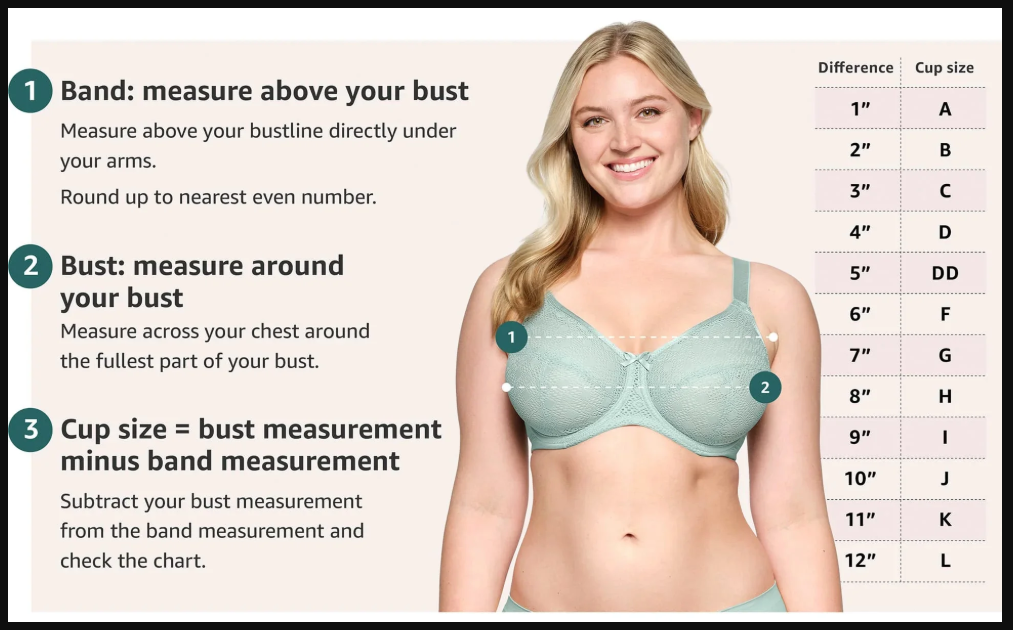
Your bra size is simply a ratio. The number (e.g., 38) represents the circumference of your ribcage. The letter (e.g., F) represents the difference between your ribcage and the fullest part of your bust.
Here is the golden rule of inches to cup size:
- 1 inch difference = A Cup
- 2 inch difference = B Cup
- 3 inch difference = C Cup
- 4 inch difference = D Cup
- 5 inch difference = DD Cup
- 6 inch difference = E Cup (UK) / DDD (US)
- 7 inch difference = F Cup (UK) / G (US)
- 8 inch difference = FF Cup (UK) / H (US)
Because plus-size bodies often have beautiful, natural "squish" around the ribcage, measuring in inches allows us to take three distinct underbust measurements (loose, snug, and break-the-tape tight). This tells our algorithm exactly how much "give" your body has, ensuring we never recommend a band that is painfully tight, nor one that is loosely unsupportive.
Bra size calculator for plus size in cm
While inches dominate the US and UK markets, many of our European and international readers prefer working in the metric system. We intentionally designed this tool to function flawlessly as a bra size calculator for plus size in cm.
Measuring in centimeters actually offers a higher degree of precision because the increments on the tape measure are significantly smaller. If you select "Centimeters" in our tool above, you don't need to worry about doing any complicated math or dividing by 2.54.
The algorithm will take your centimeter inputs, calculate your exact volume ratio, and can even output your size in standard EU sizing format (where band sizes jump in increments of 5cm, such as 85, 90, 95, 100, etc.). Just remember, whether you use inches or cm, the tape should always be kept level and parallel to the floor, especially when measuring across your back.
Bra size calculator USA (vs UK Sizing)
If you are a curvy woman living in the States, searching for a reliable bra size calculator USA can induce a migraine. The brutal reality of the American bra industry is that sizing is a chaotic, non-standardized mess once you get past a DD cup.
In the US, brands simply cannot agree on the alphabet. After a DD cup, Brand A might go: DDD, DDDD, G. Meanwhile, Brand B might go: E, F, G, H. It varies wildly. You can be an H cup at Lane Bryant, an F cup at Torrid, and a G cup at Wacoal.
This is exactly why our calculator prominently features and heavily recommends UK Sizing for anyone with a full bust. The United Kingdom has a highly standardized, logical sizing system that is virtually identical across all the best full-bust brands in the world (such as Panache, Elomi, Freya, Sculptresse, and Curvy Kate). By shopping using your UK size, you unlock a treasure trove of bras actually engineered to support heavy tissue.
| Bust to Underbust Difference | US Cup Size (Often Varies) | UK Cup Size (Standardized) |
|---|---|---|
| 4 inches | D | D |
| 5 inches | DD (or E) | DD |
| 6 inches | DDD (or F) | E |
| 7 inches | G (or DDDD) | F |
| 8 inches | H | FF |
| 9 inches | I | G |
| 10 inches | J | GG |
| 11 inches | K | H |
| 12 inches | L | HH |
How to measure bra size for plus size?
We are going to take five specific measurements. You will need a soft, flexible measuring tape. Strip down to your bare skin, or wear your thinnest, unpadded bralette (do not wear a push-up or heavily molded bra for this).
Step 1: The Three Band Measurements
Plus-size ribcages are dynamic. We need three measurements to find the "sweet spot" of support.
- The Loose Underbust: Wrap the tape directly under your breasts where the bra band sits. Keep it parallel to the floor. Let it rest gently on your skin—don't pull it tight. Breathe normally and record the number.
- The Snug Underbust: In the exact same spot, pull the tape so it feels pleasantly snug, but not digging in. This simulates how a supportive bra band should feel on your body.
- The Super Tight Underbust: This one is crucial! Exhale all the air from your lungs, and pull the tape measure as tightly as you possibly can. Pretend you are trying to snap the tape in half. This tells our calculator your absolute minimum skeletal measurement.
Step 2: The Two Cup Measurements
This is where we map your volume and projection.
- The Standing Bust: Stand up straight and relaxed. Wrap the tape around the fullest part of your bust (usually across the nipples). Do not pull tight; you don't want to squish or compress any breast tissue.
- The Leaning Bust (The Secret Weapon): Bend forward at the waist at a 90-degree angle, so your back is flat like a table. Let gravity pull your breast tissue forward. Wrap the tape around the fullest part of the hanging tissue. For plus-size women, this measurement is frequently 2 to 6 inches larger than the standing bust, and is the absolute key to eliminating spillage!
The Importance of Shape (Why T-Shirt Bras Betray You)
If you've ever put on a bra in the "correct" size, only to find the underwire aggressively stabbing your armpits while the top of the cup gapes open like an empty bowl, you are experiencing a shape mismatch.
Most mall brands sell molded, seamless T-shirt bras. These bras are manufactured by stretching fabric over a rigid metal mold. They demand that your breasts conform to their shape (which is typically wide, tall, and shallow). If you have plus-size, pendulous, or highly projected breasts, your tissue will push against the cup, forcing the underwire down onto your ribs.
The solution? Unlined, seamed fabric bras. Often styled as balconettes with 3 or 4-part cup construction, these bras use seams like architectural support beams. Because they are made of soft fabric, they conform to your natural shape, providing unbelievable lift, separation, and comfort without the rigid foam.
The "Scoop and Swoop" Technique
I cannot stress this enough: putting on a bra properly can change your size by two whole cups. Never just clasp your bra and walk out the door. You must "Scoop and Swoop."
- Lean forward slightly.
- Reach your opposite hand inside the bra cup, reaching all the way around to your side/armpit area.
- Firmly grab your breast tissue and scoop it forward, swooping it completely inside the underwire.
- Pull the underwire up so it sits snugly in your inframammary fold (the crease where your breast meets your chest).
If you scoop and swoop and suddenly have quad-boob spilling out the top, congratulations! The bra is too small in the cup, and it's time to size up.
Real Women, Real Fits: Reviews
Don't just take our word for it. Here is what curvy women are saying after ditching the department store fitters and utilizing our 5-measurement calculator:
"For literally 15 years I wore a 42DD because it was the biggest cup my local mall carried. My straps dug craters into my shoulders and my back ached daily. I used this calculator and it told me I was a UK 38FF. I thought it was a joke, but I ordered an Elomi bra in that size. I literally cried in my bedroom when I put it on. The band supports the weight, not my shoulders! Life changing."
— Sarah M., Chicago, IL
"After having three kids and losing some weight, my breasts are very soft and 'deflated'. Normal standing calculators put me at a C cup, but my breast tissue just spilled out everywhere. The leaning measurement on this tool accurately captured my hidden volume. I'm actually an E cup! Unlined seamed bras in my new size fit like an absolute glove."
— Jessica T., Austin, TX
"I love that this tool doesn't maliciously add 4 inches to the band! I have a soft, squishy 40-inch ribcage, and stores always tried to put me in a 44 band which would ride up to my neck within an hour. This calculator correctly put me in a 40G, and the sister sizing tips helped me navigate different brands perfectly."
— Maya R., London, UK
"I've used other complex calculators on Reddit, but this one is so much easier to use. The shape insights at the end were the cherry on top. It explained exactly why T-shirt bras always gaped at the top for me even when they fit everywhere else. I switched to balconettes based on the advice and my clothes look amazing now."
— Chloe W., Toronto, ON
Frequently Asked Questions (People also ask)
The most accurate way to measure for plus-size is utilizing the 5-point measurement method. Do not use the outdated +4 method. You must take three separate underbust measurements (loose, snug, and break-the-tape tight) to account for ribcage softness. Then, take a standing bust measurement, and crucially, a leaning bust measurement (bending forward at a 90-degree angle). The leaning measurement accurately captures the true volume of soft or pendulous breast tissue.
Numbers like 32, 34, and 36 on a bra label indicate the band size. In modern bra manufacturing, this number should closely match the circumference of your ribcage, measured snugly in inches, directly under your breasts. The band is responsible for providing 80% to 90% of a bra's structural support, so getting this number right is the most critical step in fitting. The letters (A, B, C) that follow the number represent the cup volume.
To calculate your bra size accurately, you take your most accurate bust measurement (often an average of your standing and leaning bust) and subtract your snug band measurement. Your snug band measurement becomes the number of your bra size (e.g., 38). The mathematical difference in inches between your bust and band dictates your cup letter (1 inch = A, 2 inches = B, 3 inches = C, 4 inches = D, 5 inches = DD, etc.). Because tissue density matters, we highly recommend using our 5-point calculator above to let the algorithm handle the complex math.
A 7-inch difference between your underbust (ribcage) and your overbust corresponds to a UK F cup. If you are shopping for American brands, a 7-inch difference usually translates to a US G cup, though some US brands confusingly label it as a DDDD. Always check the bra's tag to see if the brand uses standard UK or standard US sizing before purchasing to ensure a proper fit.